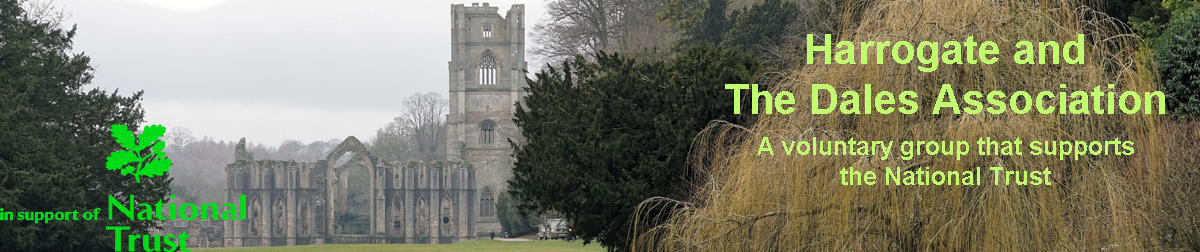
Some 50 members heard Mark Newman’s talk about the various digs conducted at Fountains in the past few years and what they, with the help of modern technological developments and interpretation, can now tell us.
The Fountains estate covers some 900 acres, although visitors mainly see the Abbey ruins. These were taken into State Care in 1967 and only became part of the National Trust from 1983.
The Abbey was founded in 1132 and became part of the Cistercian Order shortly after. The first recorded drawings of the Abbey buildings are from the 17th century – well after the Dissolution – and
“renovations” of the site: clearing undergrowth, extending a designed landscape in the 18th century, followed by excavations to provide a level surface, by removing some 12ft of soil in the 19th century, have all disturbed the archaeology, making it hard to determine what was originally there.
By the early 1980’s it was thought a stone church had replaced an original wooden one, and this in turn was replaced by the church we see ruined today. Other buildings for monastic and lay brothers had been extended over time. With the help of modern “geophysics”, ground penetrating radar and other technologies which are fast, accurate and non-invasive, it has been possible to determine the layout of previously unknown buildings – and even the monks’ cemetery of c.2,500 graves.
Mark had many interesting and often humorous accounts of the work. With the help of the University of Bradford, a new plan of the Abbey over time has been drawn and Mark will now have to update his book ‘The Wonder of the North’ to cover the Fountains and Studley findings
As always, Mark was a delight to listen to and learn from, and we hope he will return again in the future.